Managed Services: How MSPs Build Scalable Teams Through Offshore Outsourcing
Published August 26, 2026
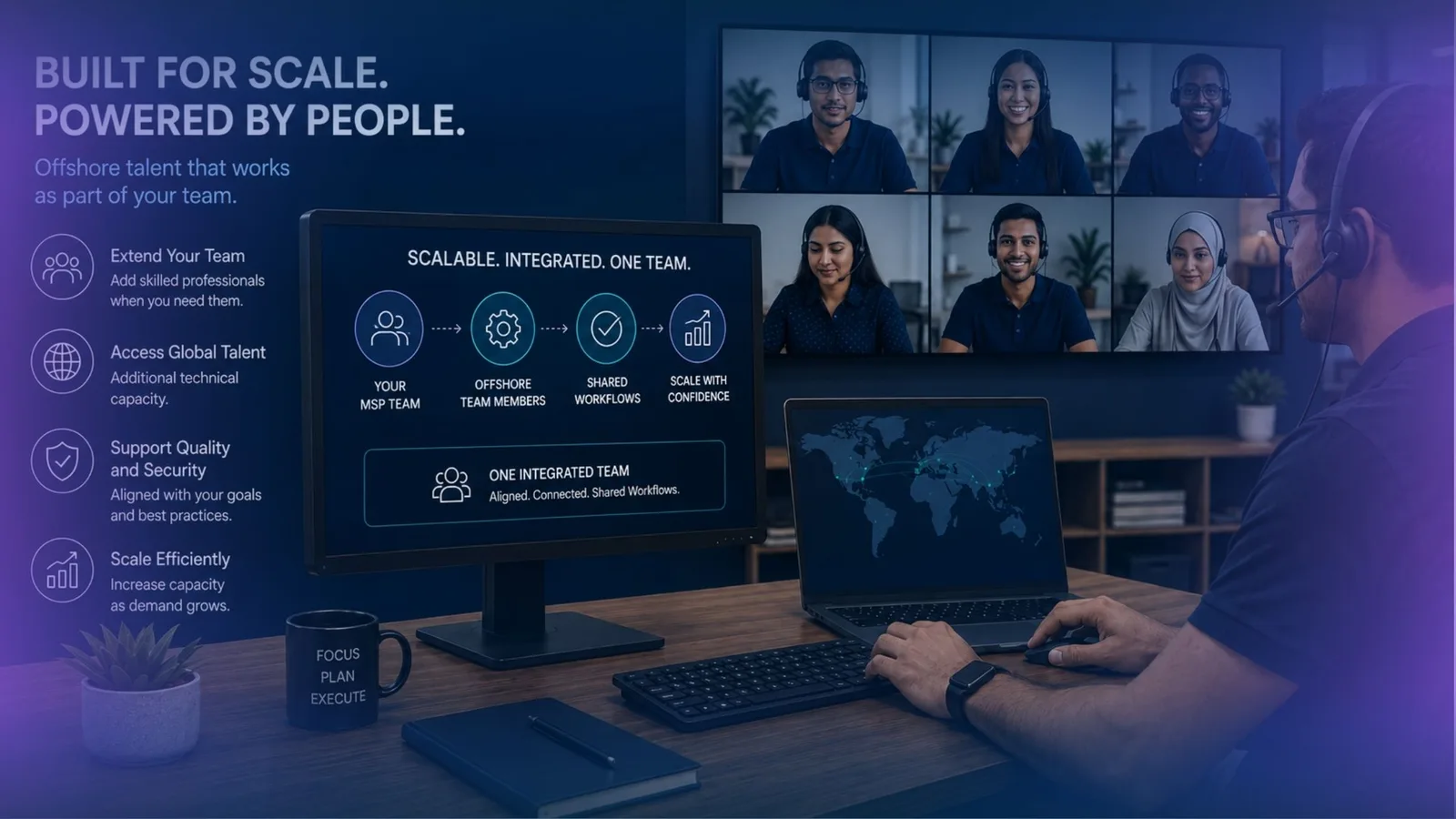
Managed services is a delivery model built on consistency. Clients pay a fixed monthly fee because they expect predictable outcomes: systems stay up, tickets get resolved, and their IT environment runs without constant intervention. When your team cannot keep pace with that promise, the model breaks down.
The staffing gap is where most growth-stage MSPs stall. US hiring is slow and expensive. Managed NOC services require continuous coverage that is difficult for lean teams to sustain without adding significant headcount cost. And generic outsourced IT services often trade short-term savings for the team integration that makes managed services work.
There is a better model. Here is what it looks like and how to evaluate whether it fits your MSP.
Key Takeaways
- Managed services delivery depends on team consistency, not just headcount.
- Managed NOC services and managed IT support both benefit from team members with deep institutional knowledge of your client environments.
- Offshore outsourcing through an embedded model can help reduce staffing costs compared to equivalent US hiring, depending on role and engagement terms.
- South African tech professionals bring strong English fluency, US cultural alignment, and certified technical skills.
- NetOps Africa handles payroll, compliance, and HR while you lead the team directly.
What Managed Services Actually Requires From Your Team
According to Gartner's definition, managed services involves proactive, ongoing management of a client's IT environment under a fixed fee. That word proactive is the key distinction. You are not reacting to incidents. You are preventing them, documenting environments, managing change, and maintaining service levels across every client simultaneously.
That scope demands team members who know your clients' environments, understand your escalation procedures, and can work within your PSA and RMM without constant supervision. Contractors who cycle in and out often struggle to reach that level of familiarity quickly, which is why team continuity tends to be a stronger predictor of service quality than headcount alone.
The Staffing Challenge Behind Managed NOC Services
Managed NOC services involve continuous monitoring of client networks, alert triage, and escalation before issues reach end users. For many MSPs, particularly those at the growth stage, maintaining consistent NOC coverage is one of the harder staffing problems to solve. CompTIA's managed services industry research notes that staffing and talent acquisition consistently rank among the top operational challenges MSPs report year over year.
On the cost side, the US Bureau of Labor Statistics reports a median annual wage for computer support specialists that, when considered alongside the additional costs of benefits, payroll taxes, and management overhead, can represent a significant burden for growth-stage MSPs operating on tight margins. The actual fully loaded cost will vary by organisation, but the gap between base salary and total employment cost is a real planning consideration.
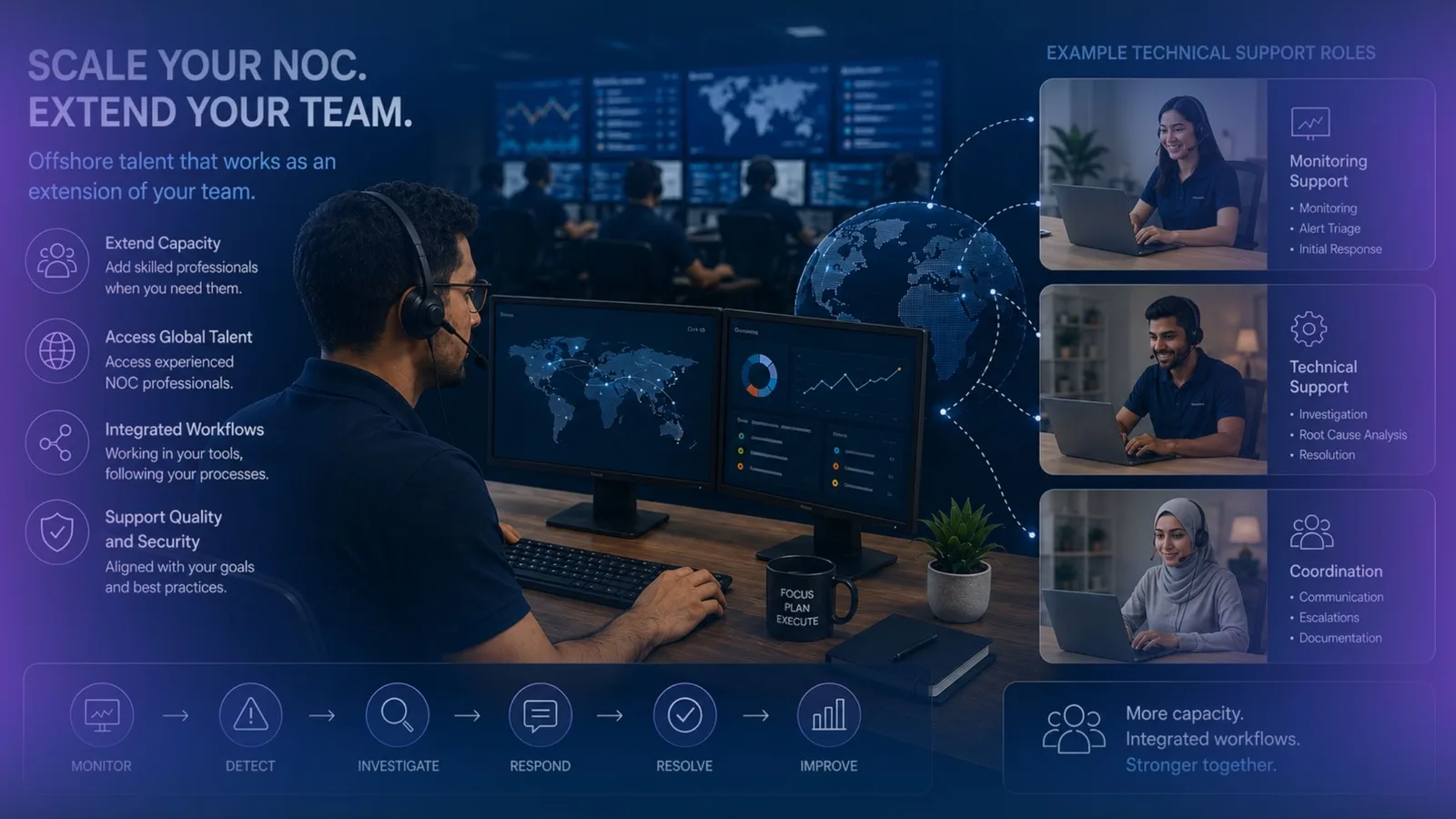
Offshore outsourcing can address the NOC coverage and cost challenge directly, provided the model is embedded rather than arm's-length. A team member who works in your tools, follows your runbooks, and escalates to your engineers functions as an operational extension of your team rather than a separate service layer.
Offshore Outsourcing vs Outsourced IT Services: A Practical Comparison
These two terms get used interchangeably but they describe fundamentally different arrangements. The distinction matters most when something goes wrong with a client.
Traditional Outsourced IT Services
With a traditional outsourced IT services model, you hand a function to a third-party provider who manages it on their terms. Consider a scenario where a client reports a recurring connectivity issue. Under a traditional outsourced model, your account manager logs a ticket with the provider, the provider's team investigates on their schedule, and you receive an update hours later with limited visibility into what was checked or why. You cannot directly question the technician, review their notes, or redirect their approach. The service layer between you and your client limits both your responsiveness and your ability to course-correct.
Offshore Outsourcing via Embedded Model
In an embedded model, the same connectivity issue plays out differently. Your offshore team member is in your PSA, has access to your client's documentation, and can be reached directly in your team's communication channel. You can see their notes in real time, ask follow-up questions, and loop in a senior engineer the same way you would with a local hire. The client experience is indistinguishable from fully domestic delivery.
For managed services and managed NOC services, the embedded approach tends to preserve team cohesion and accountability more effectively than traditional outsourced arrangements, though outcomes will vary depending on how well the model is implemented. CompTIA's research consistently finds that MSPs prioritising team stability and process consistency tend to outperform peers on client retention and net margin.
Why South Africa Is a Strong Fit for Managed IT Support
South African tech professionals match the requirements of US managed IT support roles across several key dimensions. English is the primary business language. Work culture aligns closely with US professional norms around accountability and client service. Time zone overlap supports a meaningful shift covering US Eastern and Central hours.
Certifications relevant to managed services roles, including CompTIA A+, Network+, Microsoft, and ITIL credentials, are well-represented in the South African talent market. On labour costs, SHRM's compensation data illustrates the significant gap between US technical hiring costs and offshore equivalents, a gap that NetOps Africa clients have found material to their margin planning. Specific savings will vary by role, seniority, and engagement terms.
NetOps Africa's vetting process screens for technical competency, communication quality, and cultural alignment before any candidate reaches you for consideration.
How NetOps Africa Builds Managed Services Teams
NetOps Africa's offshore staffing model is purpose-built for US MSPs. The process is designed to feel like direct hiring rather than vendor onboarding:
- You define the role, technical requirements, and cultural criteria
- NetOps Africa delivers a curated shortlist of vetted candidates
- You interview and select the person you want
- Your new team member onboards into your tools and workflows from day one
- A 90-day trial period gives you a full evaluation window before any long-term commitment
- NetOps Africa manages payroll, compliance, and HR throughout the engagement
You lead the team. NetOps Africa removes the administrative complexity of international employment so you stay focused on service delivery. Hiring timelines will depend on role specifics and candidate availability, though the pre-vetted talent pool is designed to move faster than a cold domestic search in most cases.
Is Offshore Outsourcing Right for Your MSP Right Now?
This model tends to work best when headcount gaps are delaying new client onboarding, senior engineers are regularly pulled into Tier 1 and NOC tickets, and domestic hiring costs are creating margin pressure that limits your growth options. The specific cost thresholds will vary by organisation. The 90-day trial limits your risk, but the model performs on a stable operational foundation. If your processes and runbooks are not documented, that is the better starting point.
Break Down Your Managed Services Staffing Bottleneck
If hiring delays, NOC coverage gaps, or rising labour costs are limiting your MSP's growth, the staffing structure is worth examining closely.
See how this would work in your MSP. Contact NetOps Africa to map out a scalable managed services team structure and understand what embedded offshore talent could look like for your business within 90 days.
Frequently Asked Questions
What are managed services and how do they differ from break-fix IT?
Managed services is a proactive IT delivery model where a provider takes ongoing accountability for a client's IT environment under a fixed monthly fee. Break-fix IT responds to problems after they occur and bills by the incident. The managed services model requires consistent staffing and deep client knowledge that reactive arrangements typically do not build.
What are managed NOC services?
Managed NOC services, or network operations center services, involve continuous monitoring and management of a client's network infrastructure. A NOC team watches for alerts, triages incidents, and escalates issues before they affect end users. For many MSPs, staffing a NOC domestically involves significant cost, which makes offshore outsourcing through an embedded model a common approach.
What is the difference between offshore outsourcing and outsourced IT services?
Traditional outsourced IT services hand a function to a third-party provider who manages it independently on their own terms. Offshore outsourcing via an embedded model means the remote team member works under your direct management, using your tools and processes. For managed services delivery, the embedded approach tends to preserve the team integration and accountability that generic outsourced IT services arrangements can make difficult.
How does managed IT support benefit from offshore outsourcing?
Offshore outsourcing through an embedded model allows MSPs to staff managed IT support roles at a lower cost than US equivalents, without sacrificing team integration or service quality. Team members are onboarded into your PSA, RMM, and documentation, and managed directly by you, which supports the consistency managed IT support delivery requires.
How quickly can NetOps Africa place a managed services team member?
Timelines will vary based on role requirements and candidate availability. NetOps Africa maintains a pre-vetted talent pool, which is designed to reduce the time between initial scoping and candidate shortlist compared to starting a domestic search from scratch. A 90-day trial period gives you a full evaluation window before any long-term commitment is required.